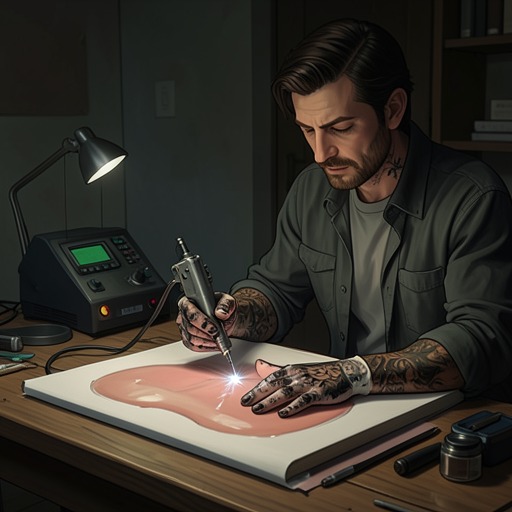
Jungkook's sketchbook
𝐋𝐚𝐜𝐮𝐧𝐚 | 𝑱𝒆𝒐𝒏 𝑱𝒖𝒏𝒈𝒌𝒐𝒐𝒌Jungkook’s sketchbook is more than a notebook for casual drawings: it is the material surface on which his most difficult impulses become legible. During a night when sleep has abandoned him and anger urges him to find Josh, Jungkook uses drawing to divert the violent thought. Yet the sketchbook does not simply silence what he feels. It gives those feelings another form, allowing desire, frustration, and an emerging attachment to Shelby to appear before he can acknowledge them openly.
Definition and Material Presence
The sketchbook is a portable, private object that Jungkook reaches for when ordinary rest and conversation fail him. Its presence links several otherwise separate moments: he carries it into his room, opens it with a pencil, closes it after completing a drawing, and later returns to it while Shelby is nearby. The repeated gestures of taking it out, drawing, and putting it away give the object a quiet ritual function. It creates a controlled space for emotions that Jungkook does not yet know how to express directly.
The notebook is especially important because Jungkook’s body and surroundings are often charged by conflict. He is sleepless, consumed by anger, and tempted by retaliation, but the sketchbook offers a nonviolent activity through which that pressure can be redirected. The act of drawing slows the movement from thought to action. It does not erase his rage or restore his sleep, but it prevents the destructive impulse from becoming the only available response.
Sleeplessness, Anger, and Displacement
On Saturday morning, Jungkook has slept for only three hours. His demons whisper that he should find Josh and settle the matter as quickly as possible, while his anger keeps him from returning to sleep. To get the dark idea out of his mind, he draws his deepest desires, including desires that are sensual and lustful. The sketchbook therefore receives both sides of his unrest: the aggression he wants to escape and the erotic energy that continues to occupy him.
This use of the notebook is a form of displacement. Jungkook cannot act on his anger without consequences, and he cannot simply command his mind to become calm. Drawing becomes the intermediate action between impulse and restraint. The private page allows him to remain active without confronting another person, while also revealing that his inner life is not organized around a single emotion. Violence, desire, insomnia, and imagination coexist in the same object.
The Drawing That Becomes Shelby
The sketchbook’s most revealing moment occurs after Jungkook returns to his room and imagines the ceiling as a huge canvas. He pictures a young woman standing with her back to him, holding a glass of wine and wearing only a white shirt falling across her back, illuminated by moonlight. The image is explicitly sensual, and he immediately takes the sketchbook and a pencil to reproduce the vision that has taken hold of his thoughts.
The decisive turn comes when the completed image is not merely an anonymous fantasy. Without consciously intending to do so, Jungkook draws Shelby’s face. The sketchbook thus exposes a connection that Jungkook has not declared and may not even understand. His imagination begins with a generalized erotic figure, but the page resolves that figure into Shelby. The object makes the concealed attachment visible through an involuntary artistic substitution: what Jungkook will not say becomes present in the portrait.
After finishing the drawing, he closes the notebook and puts it away just before Namjoon knocks and enters. The timing gives the sketchbook a guarded quality. Jungkook can allow his friend into the room, but the page remains shut. He does not offer the drawing for inspection, and the intimate image stays within the notebook rather than entering conversation. The closed sketchbook marks the boundary between Jungkook’s public posture and the feelings his private art has already disclosed.
Concealed Affection and Social Denial
The sketchbook also becomes the silent counterpoint to Jungkook’s spoken denial. When others wonder why Shelby has not appeared, he knows that she is in his room, probably asleep after a nightmare, and that she embraced him when she woke. He could disclose these facts, but refuses because he does not want anyone to believe that the two of them are beginning to appreciate one another or might develop a friendship. Instead, he keeps the relationship hidden and draws a few flowers here and there in his notebook. The flowers are not explained as a conscious confession, yet their gentleness contrasts sharply with the hostility Jungkook wishes to display. The sketchbook preserves what his words suppress: concern, tenderness, and the possibility of attachment.
This contrast makes the notebook an instrument of narrative revelation. Jungkook’s dialogue maintains distance, while his drawings repeatedly undermine it. The erotic portrait accidentally gives Shelby a face; the later flowers accompany his refusal to admit that she matters to him. In both cases, drawing operates as an involuntary disclosure rather than a deliberate declaration. The object does not make Jungkook honest in speech, but it makes his evasions readable.
Portraiture and Shared Observation
The sketchbook eventually crosses the boundary between private refuge and shared activity. When Jungkook tells Shelby that he does not want to be alone, she agrees to remain with him. He undresses to his boxer shorts and lies on the bed, while Shelby sits at her desk and takes the sketchbook to make another drawing. Wanting to draw a portrait, she turns toward Jungkook, who is lying comfortably on his stomach with his arms crossed beneath the pillow.
This scene reverses the earlier arrangement. Jungkook had used the notebook to draw Shelby without her knowledge; now Shelby uses it while directly observing him. The sketchbook becomes a medium of reciprocal attention, even though the evidence does not turn the moment into an explicit verbal confession. Its function changes from solitary containment to shared looking. The person once transformed into an unconscious image is now present as the subject of an intentional portrait, and the notebook holds both sides of that exchange.
Repetition and Narrative Significance
Across these episodes, Jungkook’s sketchbook gathers impulses that cannot yet coexist comfortably in ordinary interaction. It receives anger redirected away from Josh, sensual fantasies, an unconscious image of Shelby, private flowers, and a portrait made while the two characters occupy the same room. Each use changes the emotional value of the object. It begins as a tool for surviving sleepless rage, becomes evidence of concealed desire, and finally serves as a quiet bridge between two people who remain guarded in speech.
The notebook’s importance lies in its material patience. It does not demand an explanation from Jungkook, contradict him, or force him to name what he feels. Pages can hold contradictions without resolving them: violence beside tenderness, erotic fantasy beside embarrassment, secrecy beside intimacy. Because the narrative returns to the same simple actions—taking out the sketchbook, drawing, closing it, and returning to it—the object makes emotional change visible through repetition. Jungkook may continue to claim distance, but the drawings progressively record a different relation to Shelby.
The Sketchbook as Emotional Evidence
Jungkook’s sketchbook therefore functions as both an object and an informal record of his inner transformation. It externalizes feelings that remain inaccessible in conversation, while preserving the gap between the identity Jungkook performs and the attachments his actions reveal. Its pages do not resolve his anger or guarantee that his relationship with Shelby will become secure, but they establish that his inner world has already shifted: Shelby has entered his imagination, his concern, and his art.
The decisive evidence is not a grand declaration but the accidental face on the page and the continued return to drawing when sleep, anger, and loneliness overwhelm him. The sketchbook turns hidden emotion into something visible without making it fully spoken. In that sense, it is the quietest witness to Jungkook’s developing tenderness and to the first movement from defensive isolation toward connection.